


Securing seed-stage funding in 2026 requires more than a visionary idea; it requires a calculated, data-backed narrative that proves market readiness. For startups in the United States, the competition for Venture Capital (VC) is fierce, with investors increasingly prioritizing “capital efficiency” and clear paths to profitability. A seed-stage proposal is your primary tool to demonstrate that you aren’t just building a product, but a scalable business.
The Problem-Solution Fit: Defining the “Pain”
Every successful US startup begins by identifying a pervasive market gap. According to 2025 Bureau of Labor Statistics data, nearly 20% of new businesses fail within their first year due to a lack of market need. To avoid this, your proposal must quantify the problem. For instance, if you are developing a B2B logistics tool, cite specific industry losses due to supply chain fragmentation.
When transitioning from the “problem” to your “solution,” the clarity of your documentation is paramount. Much like how a business proposal writing expert structures a high-stakes pitch, your seed proposal must move logically from a “pain point” to a “value proposition.” This section should prove that your solution is not just “nice to have,” but a “must-have” for your target demographic.
The Team: Investing in the “Jockey”
At the seed stage, VCs are betting on the founders as much as the product. A 2024 Harvard Business Review study noted that “team execution” is the top factor VCs cite for a startup’s ultimate success. In your proposal, highlight:
- Domain Expertise: Why is your team uniquely qualified to solve this specific problem?
- Resilience: Mention previous ventures or technical hurdles overcome.
- The “Gap” Plan: Acknowledge where your team is thin and how the seed funding will help you hire top-tier talent.
Go-To-Market (GTM) Strategy and Early Traction
Investors want to see that you know how to find your customers. A robust GTM strategy should outline your primary acquisition channels—whether through direct sales, partnerships, or aggressive content marketing. For many founders, the journey begins with outbound communication; understanding how to start an email to a potential lead or partner can be the difference between a cold bounce and a warm discovery call. Your proposal should include any “traction” signals you already have, such as Beta sign-ups, Letter of Intents (LOIs), or month-over-month (MoM) user growth.
Market Size: The TAM, SAM, SOM Framework
To justify a VC’s 10x return requirement, you must prove the market is large enough. Use the following hierarchy:
- TAM (Total Addressable Market): The global opportunity (e.g., The $500B Global EdTech Market).
- SAM (Serviceable Addressable Market): The portion you can reach with your current business model (e.g., US-based Higher Education software).
SOM (Serviceable Obtainable Market): What you can realistically capture in the next 2-3 years.
Key Takeaways
- Quantify Everything: Use 2025-2026 industry benchmarks to support your claims.
- Focus on the “Why Now”: Explain why the market is ready for your solution today, not two years ago.
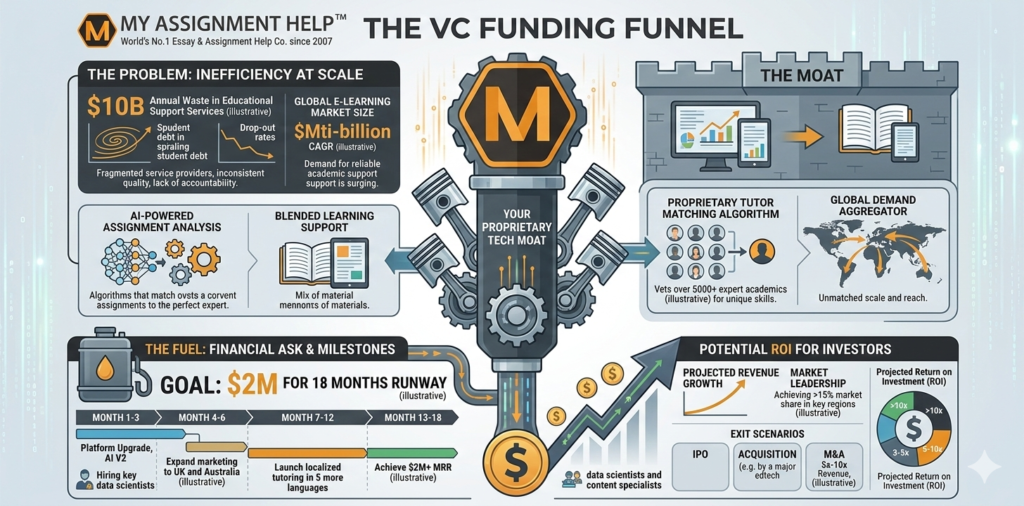
- Be Precise with Funds: Don’t just ask for $1M; explain how that $1M buys you the next specific milestone (e.g., “Product-Market Fit”).
FAQ Section
Q: How much equity should I give up at the seed stage?
A: Typically, US seed rounds involve a 10% to 25% equity dilution, though “Safe” notes are increasingly common to defer valuation.
Q: Do I need a finished product to get seed funding?
A: Not necessarily, but you do need a “Minimum Viable Product” (MVP) or strong evidence of technical feasibility and customer interest.
Q: What is the most common reason VCs reject seed proposals?
A: Usually, it is a “small market size” or a lack of clear differentiation from existing competitors.
Author Bio
James Anderson is a Senior Content Strategist at MyAssignmentHelp. With over a decade of experience in corporate communications and academic research, James specializes in helping students and entrepreneurs bridge the gap between theoretical business models and real-world execution. His work focuses on E-E-A-T principles to ensure all digital content is authoritative, data-driven, and optimized for global markets.
References:
- McKinsey & Company (2025): “The State of US Venture Capital: A 2026 Outlook.”
- Bureau of Labor Statistics: “Entrepreneurship and the US Economy,” 2025 Update.
- PitchBook NVCA: “Venture Monitor Report,” Q4 2025
