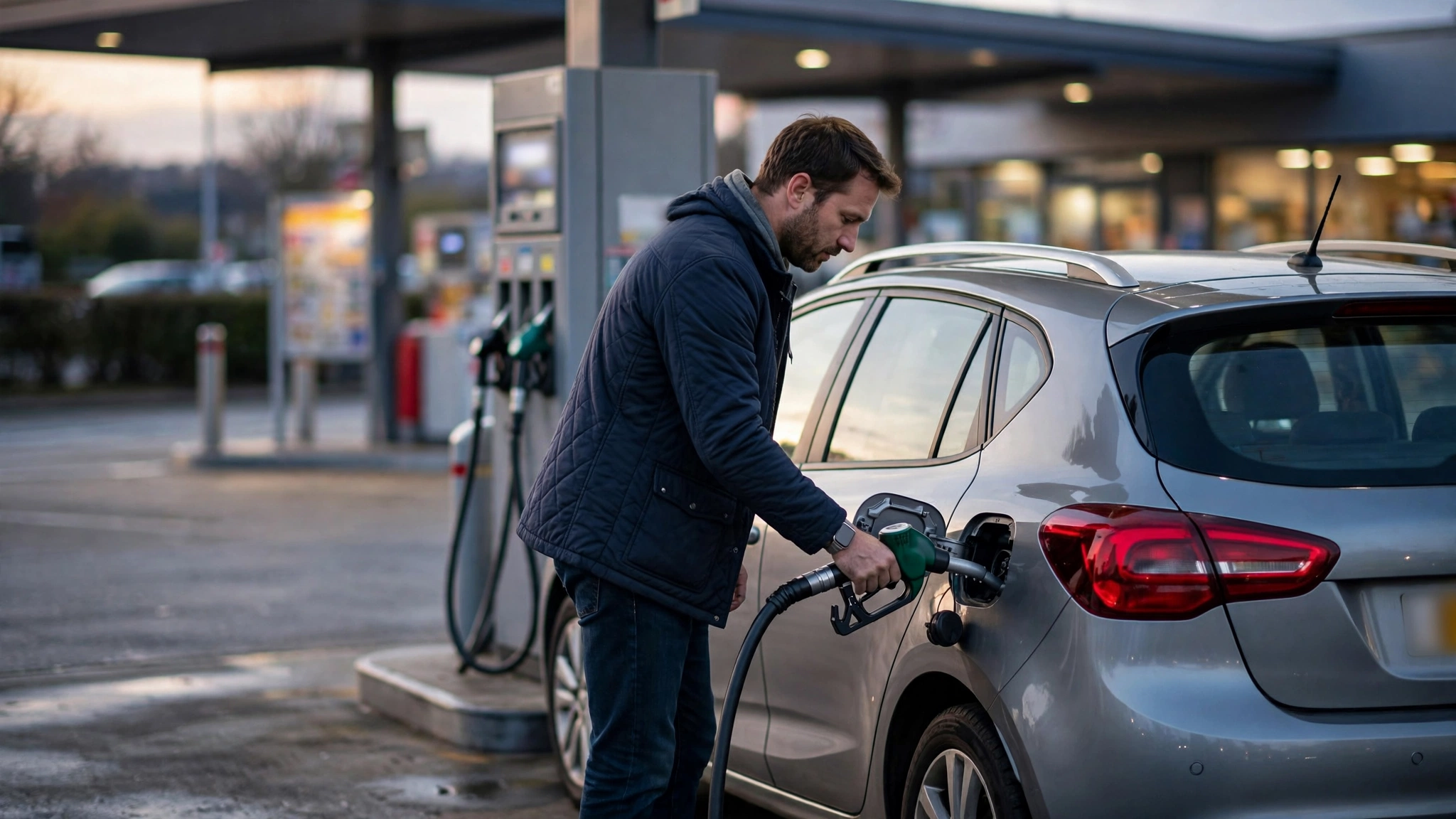
Stand in front of the garage price board on a bad week and the number looks like a verdict: this is what fuel costs now. It is not. That single number is three different costs stacked on top of each other, plus a fourth — local competition — that decides how much of the stack you actually pay. Pull them apart, and the weekly swings start to make sense. Leave them stacked, and every change feels random and every fall feels too slow.
The comparison is the point. Oil, the pound and tax do not move together, do not matter equally, and do not explain the same part of the price. Here they are, side by side.
Oil: The Raw Material, Traded in Dollars
Petrol and diesel are made from crude oil, and crude is traded around the world in US dollars. When the global oil price rises — because of wars, production cuts by exporting countries, or a surge in demand — the cost of the raw material behind every litre rises with it. When it falls, pump prices should eventually follow.
They rarely follow at the same speed, though. Prices at the pump tend to climb quickly when oil gets more expensive and drift down more slowly when it gets cheaper — a pattern drivers have complained about for years. Part of the explanation is timing: the fuel in a garage's tanks today was bought at yesterday's prices, and retailers argue they cannot cut prices until cheaper stock arrives. Motoring groups have long argued the falls still take too long, and the issue has drawn the attention of competition watchdogs more than once.
Oil, then, is the volatile slice. It explains the sharp moves, the weeks when the board jumps for no local reason at all. But it is not the biggest slice, and on its own it cannot explain why a litre costs what it does in Britain rather than elsewhere.
The Pound: The Quiet Multiplier
Because oil is priced in dollars, the strength of the pound quietly shapes what you pay. When the pound weakens against the dollar, the same barrel of oil costs more in British money, even if the global price has not moved at all. When the pound strengthens, there is room for prices to ease. It is one reason fuel can get more expensive in Britain at a moment when headlines elsewhere say oil is flat.
Compared with oil, the pound is the stealth slice. Nobody watches the exchange rate on the way to the garage, and no forecourt board explains that part of today's price is a currency move from last week. Yet for an imported commodity priced in dollars, it is always there, multiplying or softening whatever oil does. A flat oil price and a weaker pound still means a dearer litre; a falling oil price and a weaker pound can cancel each other out entirely, which is why drivers sometimes feel cheated by a fall in oil that never reaches the pump.
Tax: The Largest Slice, and the Steadiest
A large share of every litre you buy never reaches the oil company or the garage at all. Fuel duty is charged at a fixed rate per litre, and VAT is then applied on top of the whole price — duty included. In practice, tax makes up well over half of what many drivers pay at the pump, which is why changes announced in a Budget can move prices overnight, and why a freeze or cut in duty is always big news for motorists.
That also means the government benefits twice when prices rise: the duty stays the same, but the VAT take grows with the higher price. It is one of the reasons fuel taxation remains such a politically sensitive subject, and why drivers watch every Budget for one line about duty.
Tax is the opposite of oil in every way that matters for understanding the price. It is the largest slice, the steadiest slice, and the one drivers can do least about at the pump. Oil explains the swings; tax explains the level. A world in which oil fell to nothing would still leave a litre costing a substantial amount, because duty and VAT would still be charged on it. That single fact reframes most arguments about pump prices: the debate is not only about what garages charge, but about what the tax system takes before the garage sees a penny.
Local Competition: Why the Next Town Is Cheaper
If oil, the pound and tax are national, why does fuel cost more on one side of a county than the other? The answer is competition — or the lack of it. In towns with several stations fighting for custom, prices are keener. In rural areas with one garage for miles, they are not. Supermarket forecourts have traditionally been among the cheapest places to fill up, using fuel to draw shoppers into the store, while motorway service stations sit at the other end of the scale, charging a premium to drivers who have little choice mid-journey.
The gap between the cheapest and most expensive forecourt in an area can be wide enough to matter over a year of driving. Fuel may also pass through an extra layer of distribution in remote areas, adding transport costs that city stations do not face. Competition, unlike the other three slices, is the one drivers can actually act on — and it is where the practical advice lives.
You cannot control the oil market, the exchange rate or the tax system. But there is still room to spend less: shop around, using price-comparison apps and a glance at forecourt boards on your regular routes — a short detour for a full tank can be worth it, while for a small top-up it probably is not. Ease off the accelerator, because smooth driving — gentle acceleration, reading the road ahead, avoiding harsh braking — uses noticeably less fuel than aggressive driving, and it is kinder to the car. Check your tyre pressures; under-inflated tyres increase fuel consumption and wear out faster, and the correct pressures are listed in the handbook or on a sticker inside the door frame or fuel flap. Lighten the load: roof boxes, bike racks and a boot full of clutter all add weight and drag, so take them off when you are not using them. And use loyalty schemes — many supermarkets and fuel brands offer points or money-off schemes whose savings per fill are small but noticeable over a year for regular drivers.
Thinking of Changing Cars?
Fuel prices feed into a bigger decision many drivers are now weighing: what to buy next. Diesel, once the default choice for high-mileage drivers, has lost ground as tax rules and clean-air concerns have shifted against it, though it still suits some long-distance drivers. Hybrids offer a middle path, cutting fuel use in town without any plugging in. Fully electric cars are far cheaper per mile on home charging, but cost more to buy, and public rapid charging can narrow that advantage considerably. The honest answer is that it depends on your mileage, your driving pattern and whether you can charge at home — there is no single right choice, which is precisely why the decision feels harder than it used to.
The One Step Worth Taking
Pump prices will keep moving with the global oil price, the pound, and the government's decisions on duty at each Budget. None of those can be changed from the driver's seat. So take the one step that touches the only slice you can influence: before your next full tank, find the cheapest station on a route you already drive, and make it your default. Not a grand strategy, not a new car — just one cheaper forecourt, used every time, until the habit, not the headline, decides what you pay.