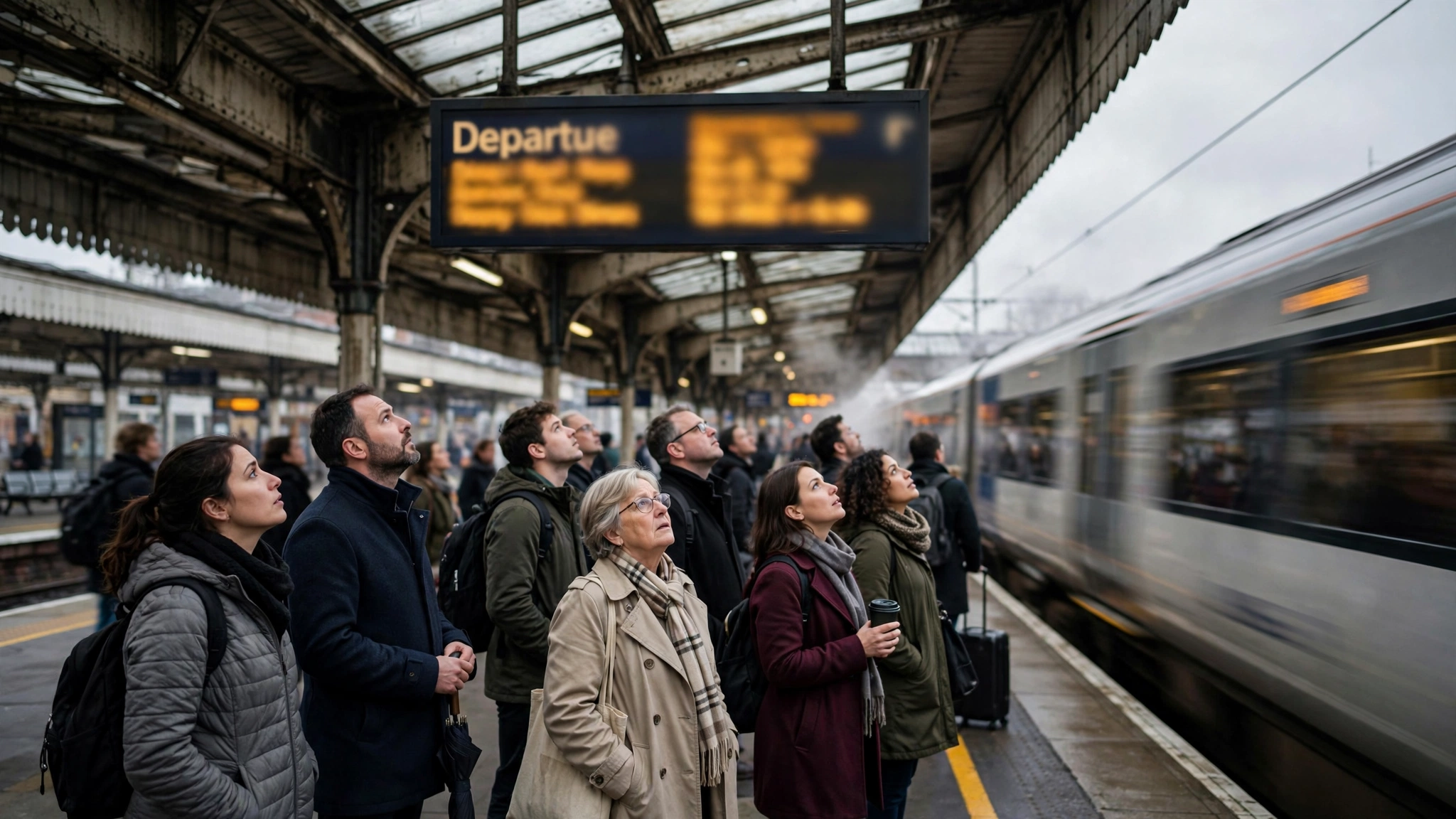
The departures board flickers, a crowd gathers under it, and a phrase nobody wants to hear echoes across the concourse: "We are sorry to announce…" For anyone who relies on Britain's railways — for work, for family, for the long-planned weekend away — disruption is not an occasional misfortune. It is a standing feature of the system, and the travellers who cope with it best are the ones who treat checking their journey as part of the journey itself.
Planned engineering works, short-notice cancellations, weather, infrastructure failures: the causes vary, but the defence is always the same. Know before you go, know your rights when it goes wrong, and always have a Plan B for the journeys that really matter.
Why Disruption Happens
A large share of disruption is planned months in advance. Britain's railway is old, intensively used, and maintained largely in the gaps — overnight, at weekends, and over bank holidays. That is why engineering works cluster precisely when leisure travellers most want to use the trains: a bridge renewal or a stretch of track replacement cannot be squeezed into a Tuesday afternoon without shutting down the commuter network instead. During major works, trains may be diverted, run to a different timetable, skip stations, or be replaced by buses for part of the route.
The rest is unplanned: a points failure on a cold morning, a signal fault, a tree on the line after overnight wind, a shortage of train crew, or an earlier delay that ripples through the timetable for hours because trains and drivers end up in the wrong places. Modern timetables run with very little slack, which makes them efficient on a good day and fragile on a bad one.
Checking Before You Travel
The golden rule is to check twice: once when you book, and again on the day — ideally before you leave the house, and once more before you leave the office or set off for the station.
- National Rail Enquiries is the central source: its website and app show live departures, platform information, disruption alerts and the planned engineering works calendar for the whole network, whichever company runs your train.
- Your train operator's app gives you the same live information with your tickets in the same place, and most allow you to set alerts for a specific journey that will warn you if it is cancelled or heavily delayed.
- Journey planners reflect engineering works in the itineraries they show, typically well in advance. If a journey you are planning for a weekend looks oddly long or involves a bus, that is usually why — the works are already in the system, waiting to catch out anyone who assumes the normal timetable applies.
- If you are travelling for something that cannot be missed — a flight, a wedding, an exam, a hospital appointment — build in a spare train. The one before the one you need is the cheapest insurance in travel.
On the Day: Reading the Signs
When disruption hits mid-journey, information is your best asset. Listen to announcements, but verify them: station screens and live apps are updated centrally and are often ahead of what staff on the ground have been told. If your train is cancelled, the next one shown on the board is not always your best option — a different route, a change at a bigger station, or a service run by another operator may get you there sooner, and staff at the station or the operator's social media teams can tell you whether your ticket will be accepted on it. During major disruption, operators commonly agree to accept each other's tickets on reasonable alternative routes, and restrictions such as peak-time rules are often relaxed. It is always worth asking rather than assuming you must wait.
Your Rights When a Train Is Cancelled or Delayed
The basic position is simpler than many passengers realise. If your train is cancelled, you are entitled to a full refund on an unused ticket from the retailer who sold it to you — and if you start your journey but abandon it because of disruption, you can return to your starting station and claim a refund on the unused portion.
If you do travel and arrive late, most operators run Delay Repay schemes. In general terms, these compensate you when your journey is delayed by a set threshold — commonly a percentage of the ticket price for shorter delays, rising to a full refund for the worst ones — regardless of what caused the delay. Claims are made online with your ticket or booking details, usually within a set period after travel. Keep hold of tickets, take a photo of them if they are paper, and note the times: the claim takes five minutes, and regular travellers who claim consistently are often surprised how much comes back over a year.
Separate arrangements apply to compensation for things like a reserved seat not being provided or a first-class carriage being withdrawn, and consumer law gives additional protection where a service was not provided with reasonable care and skill. The detail varies, but the headline is worth remembering: when the railway fails to deliver, you usually do not have to shrug and absorb it.
Season Ticket Holders
Season ticket holders sit in a slightly different position. Compensation for delays is generally worked out by treating each day's travel as a proportion of the ticket's value, claimed in much the same way as Delay Repay. Where disruption is prolonged and severe — a line closed for days, for example — operators may offer enhanced compensation or goodwill arrangements, so it pays to check their websites during major incidents rather than assuming the standard scheme is all there is. And if engineering works mean you cannot use a season ticket for an extended period, ask about your options rather than letting the value quietly drain away.
The Alternatives
Sometimes the best answer to rail disruption is not a train at all. Long-distance coaches are slower but often dramatically cheaper, remarkably reliable in all but the worst weather, and increasingly comfortable. For a group, driving and sharing fuel and parking costs can work out well — with the obvious caveats about traffic, tiredness and checking whether your destination has parking at anything like a sane price. For journeys that matter most, some travellers book a refundable coach ticket as a backup when engineering works are announced, and decide on the day. It feels like overkill right up until the morning it saves the trip.
Travelling Smart
A few habits separate the travellers who glide through disruption from those who suffer it. Travel off-peak where you can — quieter trains recover from delays faster and are pleasanter when they do not. Avoid the last train of the day for anything important; when it is cancelled, there is no next one. Keep your operator's app, a phone charger and a bit of patience in your bag. And check before you travel — every time, even on the route you have taken a hundred times. The railway's problems are rarely within your control. Being surprised by them, these days, is optional.