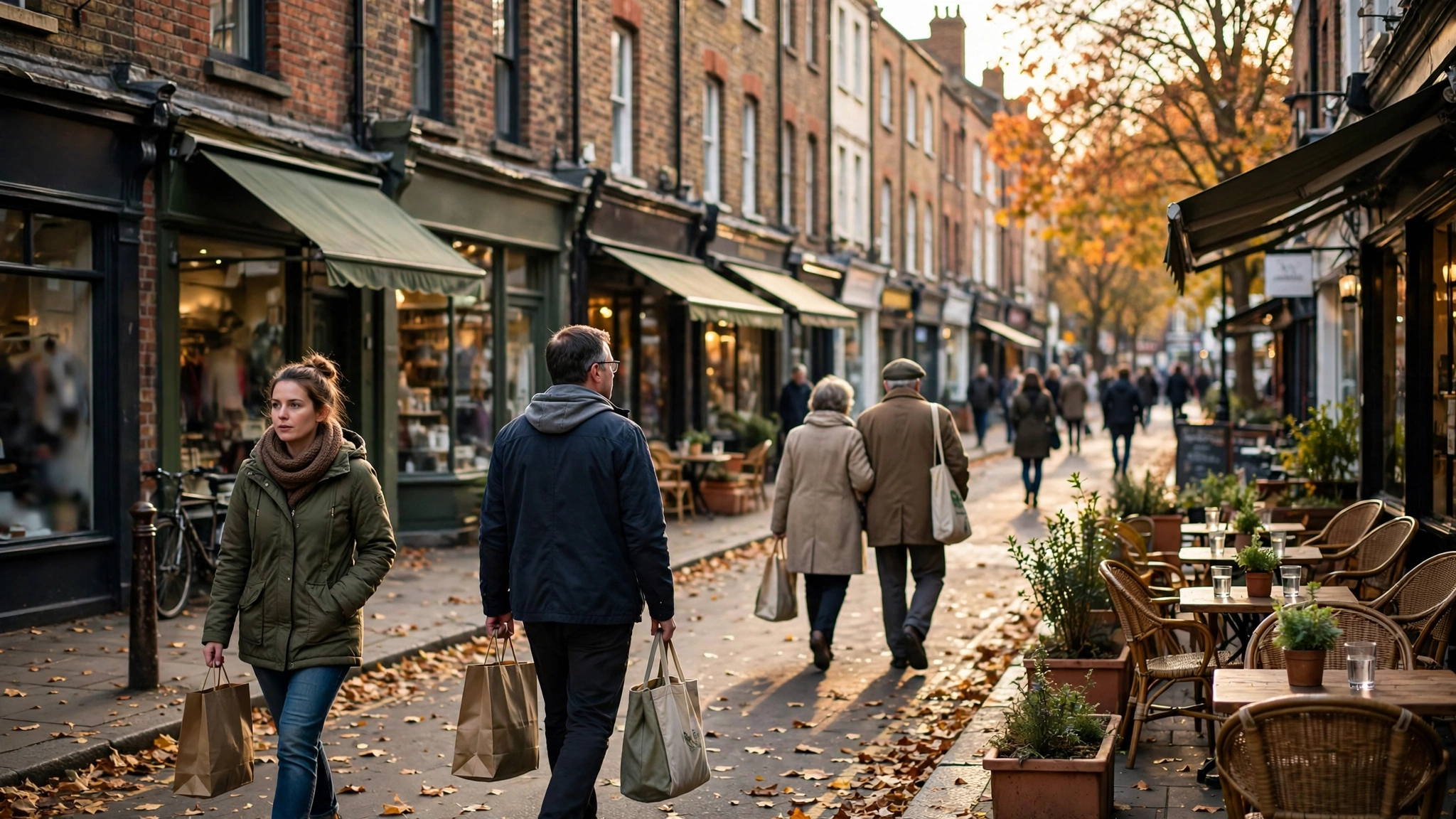
The smell of baking bread drifts out of Altrincham's covered market hall on a Saturday morning, and the streets around it are full — not with shoppers carrying bags from a department store, because that store is gone, but with people who came for lunch and stayed to browse. Some familiar names are gone from many high streets, and some shopfronts have changed use. The general story sounds abstract until you put names to it, so this is told town by town: three places that answered the same problem in three different ways, and what shoppers will notice in each this autumn.
Case one: Altrincham — the market hall that did the heavy lifting
In Altrincham, in Greater Manchester, the covered market was once surrounded by empty units; it now runs as a food hall with market stalls, and the streets around it have filled with cafes, bars and small traders feeding off the market-day crowds. The market did the heavy lifting — people came for lunch and stayed to shop.
That is the pattern in miniature. Former retail units are reopening as something else: coffee shops and bakeries, independent restaurants, gyms and yoga studios, dentists and health clinics, barbers and beauty salons, nurseries and co-working spaces. Services and experiences are taking the place of shelves and stockrooms. This matters because service businesses bring people back regularly. A shopper might visit a clothing store twice a year; a gym member or a cafe regular comes every week. The new tenants generate the footfall the old ones used to provide, just in a different way.
In Altrincham, the practical sign to look for is the market day itself: it sets the rhythm of the street. Visit on a market day, when the street is at its liveliest, and give new independents a try in their first months — early support is what keeps them alive.
Case two: Bury — the market hall as the draw
In Bury, also in Greater Manchester, the market hall itself is the draw. Its Wednesday, Friday and Saturday market days bring in shoppers from across the area, and the stalls — butchers, fishmongers, fabric sellers, hot food — give people a reason to come into town that no online shop can copy. The surrounding streets live off that regular flow.
Bury shows the independent side of the same change. Local bookshops, delicatessens, craft shops, florists, and specialist food stores are opening in streets where they once could not afford the rent — and many are thriving, because they offer something online shopping cannot: advice, atmosphere, and a human connection. An independent shop stocks a smaller range than a chain or a website, chosen for its local customers, and staff can advise in person on the products they sell. That is a different offer from ordering online, where the choice is left to the buyer.
Markets are part of the same story everywhere. Street-food markets, farmers' markets, and vintage and craft markets have grown rapidly, drawing crowds that then spill into the surrounding shops. A good market day can be the busiest day of the week for a town centre. Bury's lesson is about regularity: three market days a week, every week, beat one big event a year.
Case three: Margate — a cluster, not a scheme
Margate, on the Kent coast, shows a different route. Its Old Town, a tight grid of narrow streets behind the seafront, filled up with independent shops, galleries and cafes as the town's fortunes changed, helped by the Turner Contemporary gallery on the seafront drawing visitors into the area. Nobody planned a single scheme; a cluster of small traders, one after another, made the Old Town worth a trip in its own right.
Margate also shows the evening side of the change. Restaurants, bars, cinemas and theatres keep some streets busy after shops close, and outdoor seating and pedestrianised stretches give people somewhere to sit. Towns that invest in lighting, seating, and a clean, safe environment tend to see the benefit quickly — people linger, and lingering people spend.
The unglamorous part matters in all three towns. Towns that get this right also tend to sort out parking that is cheap or free for the first hour or two on a market day, so that a first visit costs almost nothing to try, and empty units let short-term to market traders testing a shop before they commit to a lease. None of that makes a headline, but it is the difference between a market day that works and one that does not.
What shoppers gain — and what they lose
For shoppers, the changing high street brings trade-offs. The convenience of one-stop shopping under a few big roofs has faded, and some things — particularly big-ticket goods and niche products — are now easier to buy online. But what has replaced it has its own advantages.
First, variety. A street of independents offers a more interesting mix than a row of identical chains. Second, service. Staff in small shops tend to know their products and their customers. Third, locality. Money spent in a local shop circulates locally — paying local wages, local suppliers, and local rents — in a way that money spent with a distant warehouse does not.
If your town has a loyalty scheme or a local gift card, use it: these schemes are designed to keep spending in the town. And check the practical details before you go — market day first, parking for the first hour or two, and short-let units where market traders are testing a shop before committing to a lease. Those three details are the practical signs of how a town centre is working now.
None of this is to say every high street is thriving. Some towns, particularly those that lost a major employer or that sit close to a large out-of-town shopping centre, are still struggling. Vacant units, reduced bus services, and a sense of neglect can reinforce each other, and turning that around takes real investment and patience.
Verdict: the towns winning are the ones that stopped rebuilding 2005
Altrincham, Bury and Margate point to the same verdict from three different directions. A market hall that feeds its streets, market days regular enough to build a habit around, and a cluster of independents strong enough to be a destination in its own right — each works because it is built around what people actually do now, not around the department store that left. The high street that survives this autumn will not be the one with the most shops. It will be the one with the most reasons to visit: food worth travelling for, traders who know their customers, and a market day that gives the whole street its rhythm.