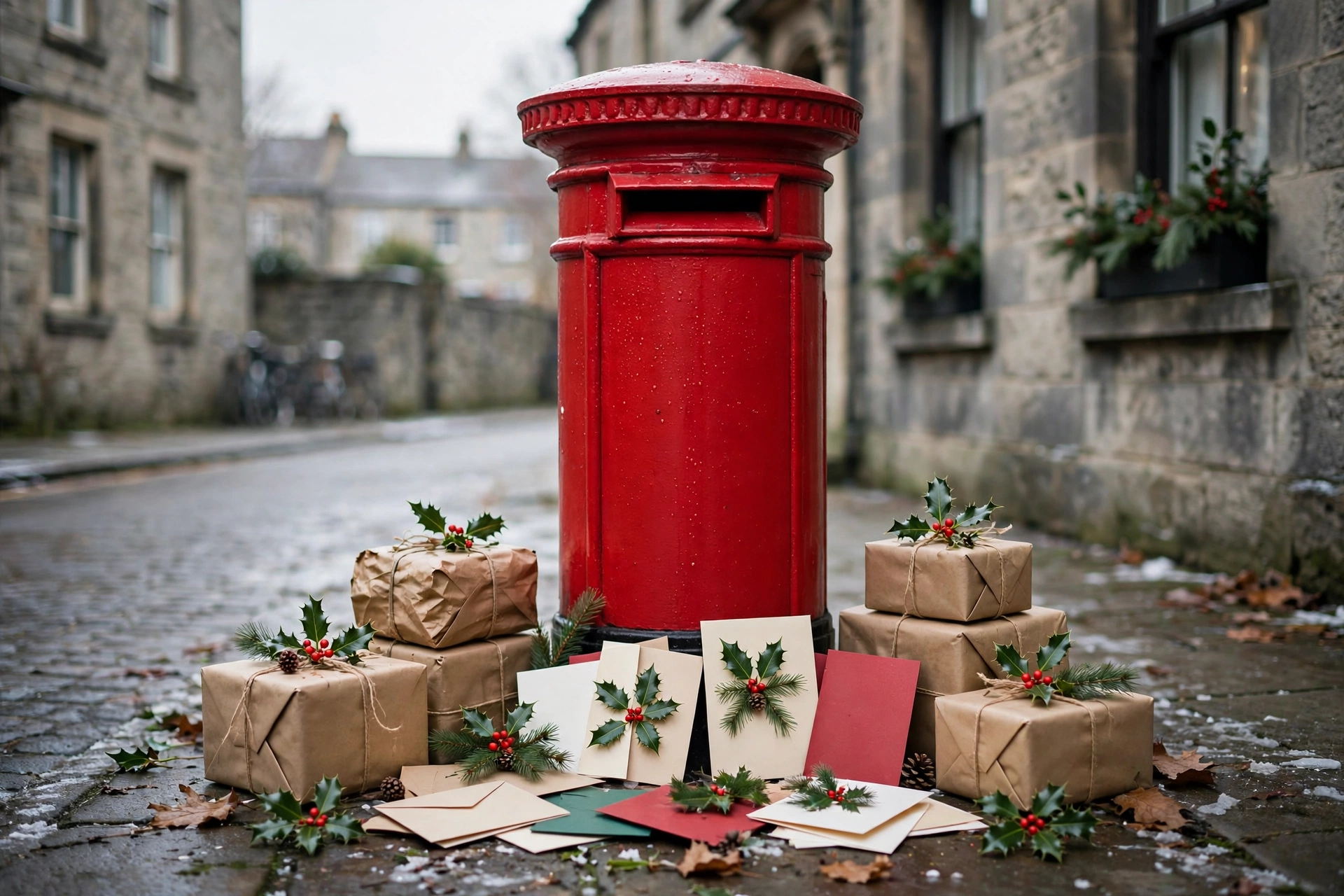
Royal Mail has now published its last posting dates for Christmas 2026, and that turns this guide from a waiting game into a working timetable. The dates are: Friday 18 December for 2nd Class and 2nd Class Signed For; Saturday 19 December for Royal Mail Tracked 48; Monday 21 December for 1st Class, 1st Class Signed For and Royal Mail Tracked 24; and Wednesday 23 December for Special Delivery Guaranteed, the latest deadline of all. Parcelforce Worldwide's UK inland dates sit alongside them: Monday 21 December for express48 and express48large, and Tuesday 22 December for express10, expressAM and express24. Royal Mail itself notes that the dates are correct at the time of publishing and subject to change, and that posting as early as possible is always the safer course. Christmas Day falls on Friday 25 December 2026, and there are no collections or deliveries on Christmas Day or Boxing Day, which is why the last few days before Christmas carry so much pressure.
The dates in plain terms
The dates only make sense once the services behind them are clear, because each one is a different bargain between price, speed and certainty. 2nd Class is the slower, cheaper letter service, and its deadline comes first: anything sent this way needs to be in the system by Friday 18 December. 2nd Class Signed For adds a signature on delivery, which suits cards and small items where proof of arrival matters, and it shares the same 18 December deadline. Tracked 48 and Tracked 24 are the tracked parcel services, with the number pointing to the delivery aim in working days, and their deadlines fall on Saturday 19 December and Monday 21 December respectively. 1st Class, the faster letter service, also closes on Monday 21 December, alongside 1st Class Signed For. Special Delivery Guaranteed is the premium guaranteed service, and it stays open latest, until Wednesday 23 December, which makes it the right choice for anything valuable or irreplaceable that has been left late.
One warning belongs with every date in this list: a last posting date is the last day an item can be expected to arrive before Christmas, not a promise that every single item will make it. Treat each date as a final backstop, and aim to post days ahead of it wherever possible. The postbox matters too: on a deadline day, the last collection time shown on the box is the real deadline, and an item dropped in after that collection counts as the next day's post.
Sort the pile before you join the queue
Most Christmas posting stress comes from treating everything as one job, when it is really three different jobs with three different deadlines. The first pile is cards. Cards are light, numerous and easy to leave until the last minute, which is exactly why they cause the longest queues. Write them in batches across late November and early December, and get the 2nd Class ones away by Friday 18 December rather than carrying a bundle to the post office in the final week. The second pile is ordinary parcels: gifts ordered online or sent between households. These belong with a tracked service, so that both sender and recipient can see where the parcel is, and they need to meet the Tracked 48 or Tracked 24 deadline depending on the service chosen. The third pile is the small one that matters most: valuable, fragile or irreplaceable items. Jewellery, handmade gifts, anything that cannot simply be bought again. Those should go by Special Delivery Guaranteed, and the Wednesday 23 December deadline should be treated as an emergency exit, not a plan.
Sorting first also avoids the common post-office mistake: a heavy gift sent by a slow service in hope, or cards sent by a guaranteed service at needless expense.
Packing and proof: the unglamorous half of posting
A well-packed parcel is the part of Christmas posting nobody photographs, and it is the part that most often decides whether a gift arrives intact. Use a sturdy box rather than a bag or a reused envelope for anything heavier than a card. Cushion the contents on all sides, so that nothing moves when the box is shaken, and tape across every opening rather than relying on a single strip. Write the address clearly and in full, with the postcode prominent, because sorting is done by machine and a smudged postcode is a common cause of delay. Put a return address on the reverse as well. If delivery proves impossible, a return address is what gets the parcel back to the sender instead of into a holding system.
Proof matters just as much as packing. Keep the receipt from the counter, or the proof of posting, until the item has arrived. For tracked and guaranteed services, keep the tracking reference somewhere it can be found quickly: the most recent scan shows the current stage of the journey, and a parcel can appear to stall for a day before moving again. If an item sent by a guaranteed service misses its guarantee, contact the provider with the details, as a claim may be possible.
Abroad and far away: where extra time is not optional
Sending Christmas post outside the UK is a different exercise from sending it within it, and the main rule is to start earlier than feels necessary. Royal Mail's own advice for international services is to post as early as possible, because higher volumes, customs checks, transport links and conditions in the destination country can all add delays that no UK deadline can control. Its published country guides set out delivery aims for each destination, and they are worth checking before wrapping anything, because a gift that needs three weeks in transit cannot be saved by a fast UK service at the end.
The same logic applies, on a smaller scale, to far corners of the UK itself. Addresses in the Highlands, on the islands and in other remote areas can need extra time, so post to those addresses in the early window rather than the final week, and choose a tracked service so the journey can be followed.
If the date has already passed
Missing a last posting date is not the end of Christmas, but it does change the options. First, check whether a later service is still open: a parcel that missed the 2nd Class deadline may still make the Tracked 24 or Special Delivery Guaranteed deadline, and a guaranteed service is worth its extra cost when the alternative is a gift arriving in January. Second, consider another carrier, whose deadlines may differ, and check them directly rather than assuming they match Royal Mail's. Third, if nothing can arrive in time, say so: a card, a message or a call telling the recipient that a gift is on its way preserves the gesture, while silence leaves them wondering whether it was forgotten.
One thing not to do is to build Christmas plans around a delivery on Christmas Day itself. There will not be one. No collections, no deliveries, on Christmas Day or on Boxing Day. Anything not delivered by Christmas Eve waits until the working days after Christmas, however important it felt when it was wrapped. That gap is the reason the whole timetable exists, and the reason the early window matters more than any single deadline.
The discipline that survives December
The households that fare best at Christmas are not the ones with the cleverest plan. They are the ones that treated late November as the posting season, sorted cards from parcels before leaving the house, packed carefully, addressed clearly, kept proof of posting, and checked the official dates rather than trusting a forwarded message or an old article. The dates for 2026 are now published and set out above, but Royal Mail notes that they can change, so the final step, before posting anything important, is to check its own page once more. Post early, use the dates as backstops rather than targets, and let Christmas Eve be the end of the timetable, not the day the posting starts.