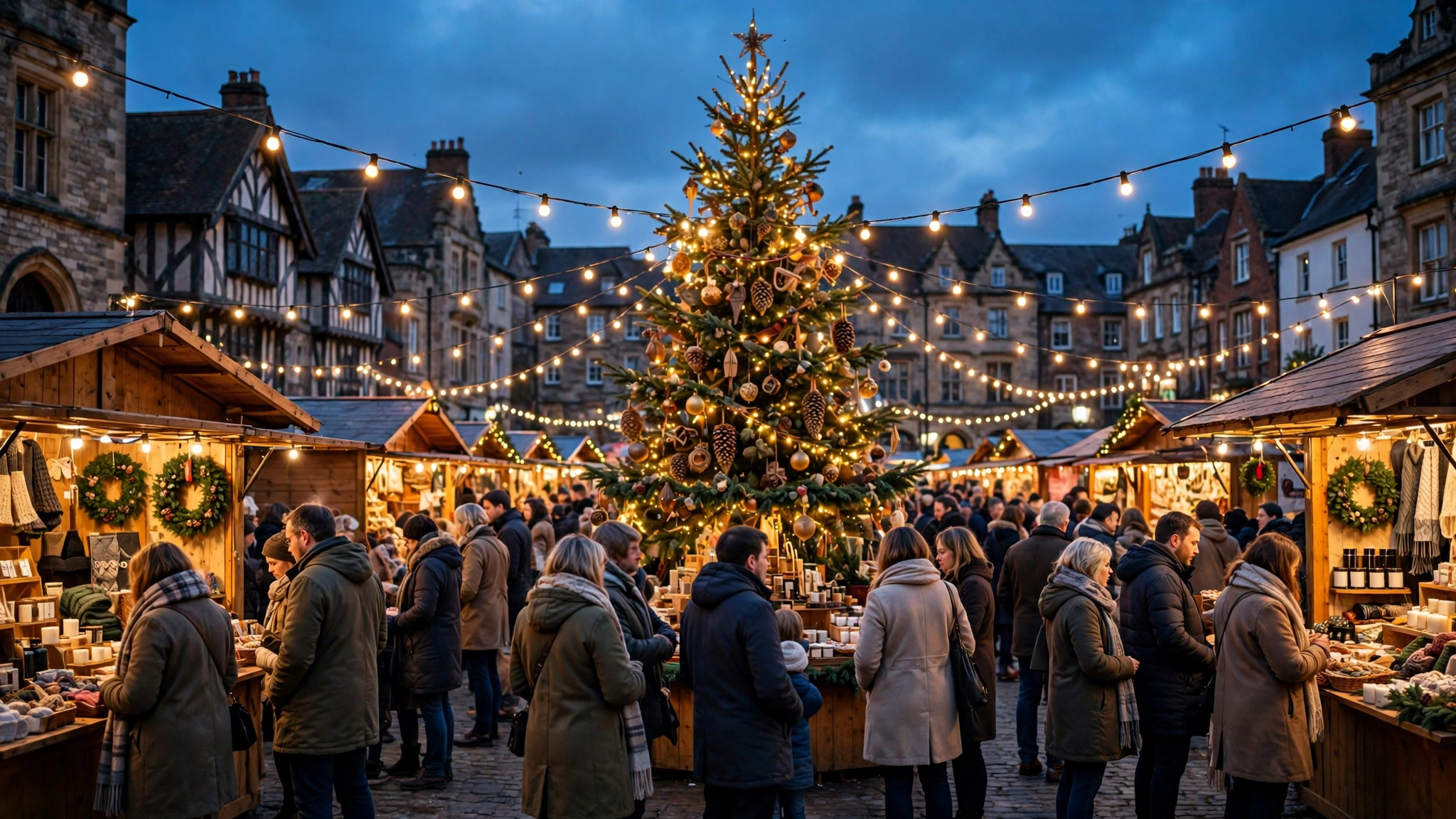
The season has its own arc. Early November brings the first lights and the first stalls; December brings the Saturday crush, when the biggest markets are at their most crowded and their most atmospheric at once; early January brings the last stalls closing, in Edinburgh above all, while the rest of the country has already packed away. Christmas markets in Birmingham, Edinburgh, Bath, Manchester and London run from early or mid-November into December or early January, with stalls selling food, crafts and gifts. The tour below follows that arc city by city, in the order a traveller might actually visit them — and the weekday rule applies to every stop: a weekday afternoon or evening is far more pleasant than a Saturday afternoon crush.
Birmingham: the Frankfurt market
Birmingham's Frankfurt Christmas Market is the largest authentic German Christmas market outside Germany and Austria. Dozens of stalls line New Street and Victoria Square, selling everything from hand-blown glass ornaments and wooden toys to bratwurst, pretzels, and stollen.
It typically opens in early November and runs until just before Christmas, making it one of the longest-running markets in the country. It is free to enter and gets extremely busy at weekends — a weekday visit, or an early evening trip, is far more enjoyable than a Saturday afternoon crush. The neighbouring Christmas in Cathedral Square adds crafts and a bandstand, and the city centre's lights and ice rink complete the day.
Edinburgh: Christmas in the capital, last to close
Edinburgh's Christmas celebrations take over the city centre, centred on East Princes Street Gardens, with a Christmas market, funfair rides, and a big wheel offering views over the city. The market stalls sell Scottish crafts, jewellery, food, and gifts, alongside the usual festive fare.
Edinburgh's markets typically run from mid-November through to early January, making them one of the last to close. Combine a market visit with the city's winter lights, a walk up Calton Hill, and the famous Hogmanay build-up if you are visiting late in December. As with all the big markets, booking accommodation early is essential — Edinburgh's hotels fill up fast in December, and December weekends most of all.
Bath: a Georgian backdrop, and a craft fair's feel
Bath's Christmas Market is one of the prettiest in the country, set among the city's Georgian crescents and the Roman Baths. The market focuses heavily on local and regional makers: jewellery, ceramics, textiles, food, and drink from the South West. It is smaller than Birmingham's, but many visitors prefer it for exactly that reason — it feels more like a craft fair than a funfair.
The market usually runs from late November to mid-December. Bath is compact, so the market, the Abbey, the Roman Baths, and the city's shops are all within a short walk. It is a good choice for a day trip by train, and the city's restaurants and tea rooms make it an easy place to spend a full festive day.
Manchester: markets across the city
Manchester's Christmas Markets spread across the city centre, with clusters in St Ann's Square, Exchange Square, Cathedral Gardens, and King Street, each with a slightly different feel. Together they form one of the largest Christmas market events in the UK, with hundreds of stalls selling gifts, crafts, food, and drink from around Europe.
The markets typically open in early to mid-November and run until just before Christmas. Manchester's markets are known for their food — German sausages, Dutch pancakes, Spanish paella, and Yorkshire pudding wraps sit alongside mulled wine and hot chocolate. The city centre is easy to reach by train, and the markets are free to enter, so the main cost is whatever you choose to eat and buy. Decide what is worth the treat — a bratwurst, a mug of mulled wine — and enjoy it, rather than grazing all day.
London: two very different markets
London offers two very different Christmas market experiences. Winter Wonderland in Hyde Park is the biggest: a huge festive theme park with a Christmas market, ice rink, circus shows, funfair rides, and food stalls. It is a full day out in itself, and several attractions are ticketed, so booking ahead is wise.
The Southbank Centre Winter Market, along the Thames, is smaller and more relaxed: wooden chalets selling crafts and street food, with views of the river and the city lights. It pairs well with a walk along the South Bank, a visit to the Tate Modern, or a show in the West End. Both typically run from mid-November to early January.
Markets are outdoors, and standing around in December gets cold. Layers, gloves, and comfortable shoes matter more than style. Most stalls take cards, but a few smaller traders are cash-only, and a cash machine queue is the last thing you want — bring cash as well as cards.
York, Winchester, and the smaller markets
Beyond the big five, several smaller markets have devoted followings. York's St Nicholas Fair, in the Shambles and Parliament Street, is one of the most atmospheric, with medieval streets dressed for Christmas. Winchester's Cathedral Christmas Market, in the cathedral close, is renowned for its setting and its emphasis on local makers. Canterbury, Chester, and Exeter also run well-regarded markets, often with a stronger local character than the biggest events.
If the big-city markets feel overwhelming, a smaller market in a historic town can be the better festive day out. Market dates vary slightly each year, so check the market's official website before booking trains or hotels, and book accommodation early for December weekends.
Verdict: match the market to the visitor
No single market suits everyone, and that is the point of the tour. First-timers who want scale should start in Birmingham, where the Frankfurt market's size and its early-November opening set the standard. Craft lovers should choose Bath or Winchester, where local makers outnumber funfair rides. Food lovers should head for Manchester. Visitors who want the season to last longest should finish in Edinburgh, where the stalls run into early January. And anyone who dislikes crowds should skip the big-city Saturdays entirely and take York's Shambles on a weekday instead. Pick the market that fits the visitor, check its dates before booking, and go on a weekday — the rest of the season takes care of itself.