Where do you start? That is the question that stops most would-be volunteers, and it is a harder one than it looks, because volunteering is not one activity. A Saturday morning marshalling a fun run and a night answering a helpline have almost nothing in common except the word. The way through is to stop asking about volunteering in general and start looking at specific roles, run by named organisations, with their own entry routes, checks and time commitments. The five below are genuinely different jobs, and one of them is usually a better fit than the abstract idea of "helping out".
Volunteers keep things running that would otherwise stop: food banks, hospital visits, helplines, charity shops, sports clubs, libraries and nature reserves. Charities could not afford to pay for all of that work, and without it services would shrink or close. People who volunteer regularly often report feeling happier and more connected, and volunteering builds skills employers value — teamwork, communication, problem-solving and reliability — along with recent experience and referees for anyone changing career or returning to work. None of that settles which role suits you. The profiles below do.
The National Council for Voluntary Organisations: the map before the role
The National Council for Voluntary Organisations (NCVO) is the place to start if you do not yet know what you want to do. It publishes guidance on getting started, and it runs the annual Volunteers' Week, which is a good moment to look if you want a prompt. Alongside it, your local volunteer centre is the single most useful first call: its staff keep a list of roles across local charities, talk through what you can offer and how much time you have, and point you at two or three roles worth trying. You can find yours through your council's website or by searching for your town's name plus "volunteer centre".
This route suits someone who has a spare few hours and no fixed idea yet. The commitment is a conversation first, not a rota. Be honest in it about time — an hour a week, a morning a fortnight, a full day a month — and about whether you want to work with people, be outdoors, or stay behind the scenes. Organisations plan around their volunteers, so two hours a week reliably beats two days promised and cancelled.
Trussell food banks: practical, regular, visible
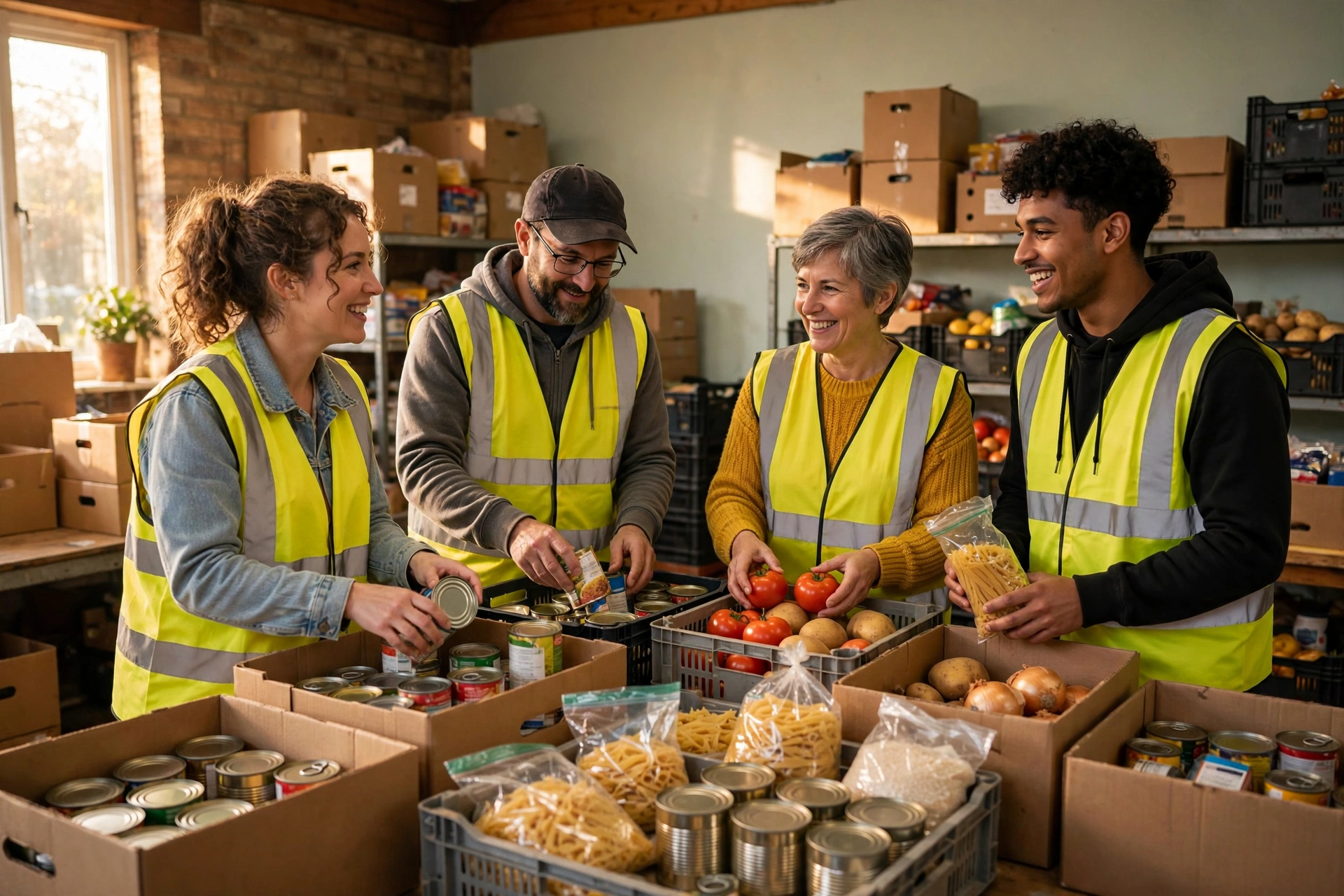
Food banks in the Trussell network take volunteers for sorting donations and packing parcels. A typical route in is a short form, an informal chat with the food bank manager, and an induction session, with no criminal-record check usually needed for parcel work. The work itself is physical and immediate: donations arrive, they are sorted, parcels are packed, and the effect is visible the same day.
This is the role for someone who wants to see the difference in a single shift and who prefers doing something practical to sitting in a meeting about it. It also shows, in miniature, what volunteering asks of organisations too: an induction, a named person to report to, and clarity about expenses. Many organisations reimburse travel costs, and some cover lunch for longer shifts. Claiming expenses is standard practice, not an imposition, and it means volunteering does not cost you money.
Royal Voluntary Service: the same person, every week
The Royal Voluntary Service places volunteers in hospitals and community settings, including befriending roles where you visit the same person each week. Those roles typically involve an application, an interview, a criminal-record check and some training before you start, because you are working with vulnerable people. That longer entry route is the point: the relationship is the role, and it only works if the same volunteer keeps turning up.
This suits someone who can commit to a regular slot and wants a relationship rather than a task. The checks are routine and nothing to worry about — the organisation arranges them and explains the process — but they do mean you cannot simply turn up on Saturday and start. If your availability is irregular, this is the wrong first role, however much the idea appeals. A good organisation would rather help you find a better fit than lose you altogether after a false start.
Samaritans: listening as the whole job
Samaritans trains listening volunteers for its helpline. There is no parcel to pack and no room to tidy; the work is listening, carefully, to people in distress, and it carries training and support to match. It is the clearest example of a volunteering role where the skill is not a trade or a pair of hands but attention itself.
This is the role for someone who is steady under pressure and comfortable with the idea that a shift may end without any visible result. It is also the role where the application and training process should be taken most seriously: if you are unsure whether you can give the time the training requires, ask before you apply rather than halfway through. People-facing roles of this kind — mentoring young people, befriending older or isolated people, supporting people in hospitals, hospices and care homes — all share the same logic. The organisation invests in you first, and then relies on you.
Parkrun: the lowest barrier in the country
At a Saturday parkrun, the volunteer roles are as simple as marshalling a corner or operating the stopwatch — turn up, get a briefing, and you are part of it. Parkrun is the free, timed 5K event held in parks every Saturday morning, and its volunteers include people who run, jog, walk, push buggies and cheer from the sidelines. Nobody finishes last, because a volunteer tail walker always takes that role.
This is the right first step for someone who wants to try volunteering without committing to a regular slot, and it sits alongside the other one-off routes: marshalling at a fun run, helping at a festival, joining a beach clean, or giving a few hours at a community event. It also answers the quiet fear behind the first-step problem — that you will be asked for more than you can give — because the ask is one morning, clearly bounded, with a briefing at the start.
Choosing honestly, then starting
The best role is one you will actually enjoy and stick with, so weigh the five profiles against each other rather than against an ideal. The NCVO route and your local volunteer centre give you breadth. Trussell gives you a visible, practical shift. The Royal Voluntary Service gives you a weekly relationship with checks attached. Samaritans gives you training and a listening role. Parkrun gives you a single morning with almost no barrier. Practical roles also exist beyond these five — conservation work with The Conservation Volunteers, skilled roles matched through Reach Volunteering, driving, gardening, DIY, cooking, helping at events — and people who prefer to work from home can help with admin, social media, translation, fundraising, or governance as a trustee or school governor.
Do not overlook the organisations you already use. If your child attends a youth club, if you walk your dog in a local park, or if a relative has been helped by a particular charity, those organisations will value a volunteer who already understands what they do. And remember that you are not an employee, and nobody expects you to be an expert on day one. Ask questions, take your time, and let the organisation know if you need support or if something is not working for you.
Where to go from here
Pick one of the five routes above and make one enquiry this week: one phone call, one form, one visit. If you have no idea which fits, start with your local volunteer centre or the NCVO guidance and let the conversation narrow it down. If you want a practical shift, contact a Trussell food bank. If you want a regular relationship, apply to the Royal Voluntary Service and allow time for the checks. If you want to listen, look at Samaritans training. If you only want to test the water, turn up at a parkrun on Saturday and ask for a marshalling brief. One enquiry, this week, is the whole plan — many volunteers say they meant to try it for a month and are still there years later, not because they feel obliged, but because they found something that mattered to them.